First long integration time project with my 10″ Meade LX200 under relatively dark Bortle 4.5 skies
One of the brightest and closest planetary nebulae to Earth (about 1,360 light-years away), M27 was the very first planetary nebula ever discovered (by Charles Messier in 1764). It formed when a Sun-like star ran out of fuel, puffed off its outer layers, and left behind a hot white-dwarf core that now lights up the expanding gas shell like a cosmic lantern. The classic “dumbbell” or apple-core shape is created by two lobes of glowing oxygen (turquoise) and hydrogen (red) seen almost pole-on.
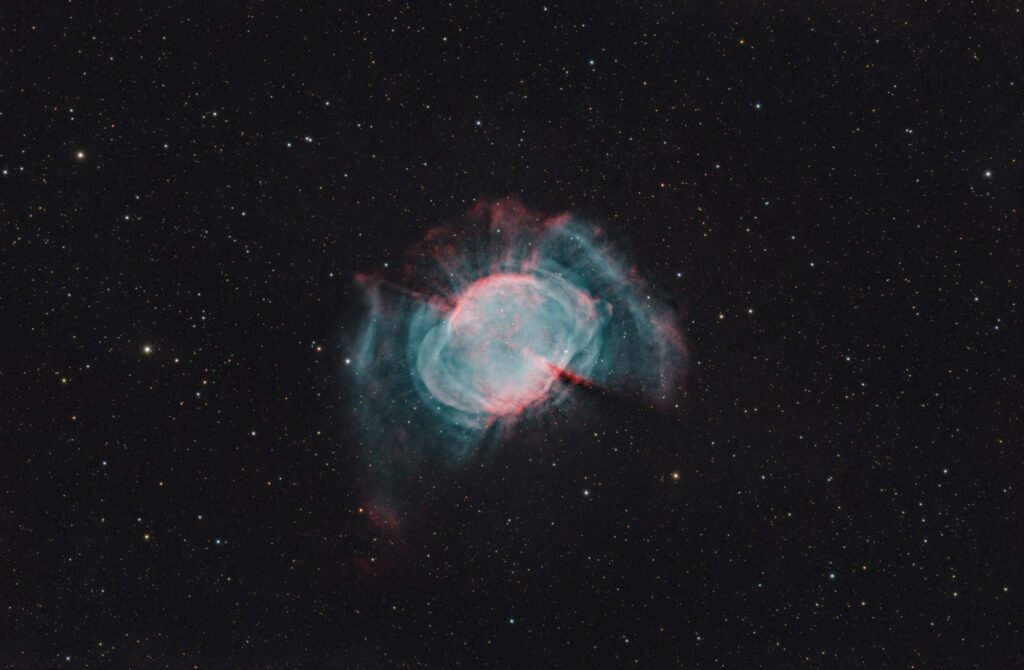
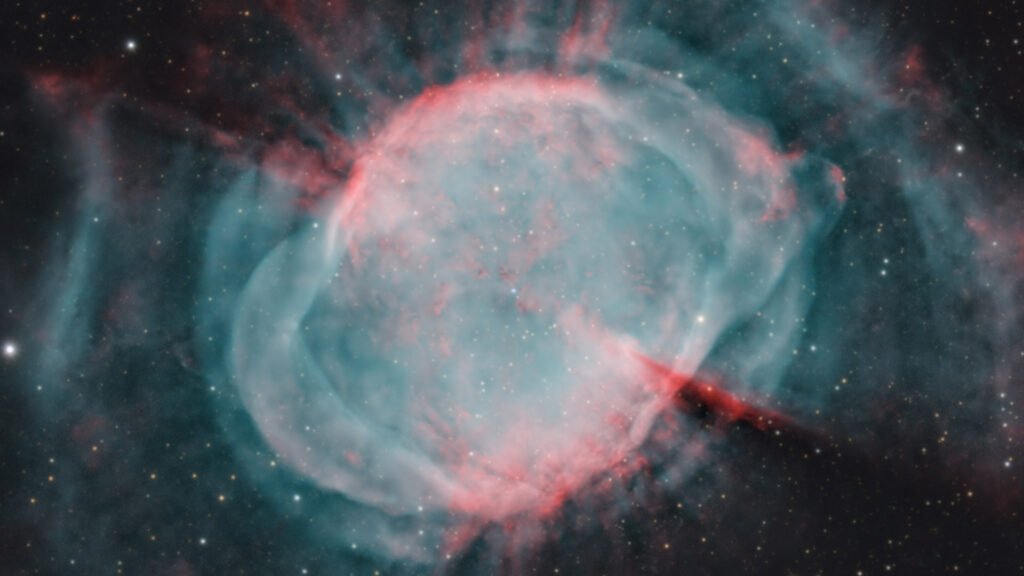
This image is my first serious long-exposure project on the newly relocated 10″ LX200 EMC. Total integration time: 18 hours
- ZWO ASI2600MC Pro (color camera)
- Scorpio 3 nm dual-band Ha+OIII filter
- Sky-Watcher EQ6-R Pro mount
- Off-axis guiding with ZWO ASI220MM Mini
- Starizona 0.63× reducer and WandererRotator Mini
I’m really happy with the detail the 10″ pulled in — the faint outer halo and the intricate knots inside the nebula are clearly visible. This was a great test run, and I’m already planning to put the mono ToupTek 26000KMA on this scope for even deeper narrowband shots later.
Hope you enjoy the view as much as I enjoyed capturing it!
Below is the video I posted about setting up 10″ Meade LX200 for deep sky astrophotography for you to check out.