What a rewarding target! NGC 1499, better known as the California Nebula, is a stunning emission nebula in the constellation Perseus that stretches an impressive 2.5° across the sky—about five times the width of the full Moon. Located roughly 1,000 light-years away, this glowing cloud of hydrogen gas (spanning around 100 light-years) owes its eerie shape to ionized hydrogen excited by the brilliant O7 supergiant star Xi Persei (Menkib), a scorching beast with a surface temperature of over 34,000°C. Discovered in 1885 by pioneering astrophotographer E.E. Barnard from light-polluted Nashville, it’s a favorite among imagers for its sprawling, California-like outline, though it’s notoriously faint visually and shines brightest in hydrogen-alpha wavelengths.
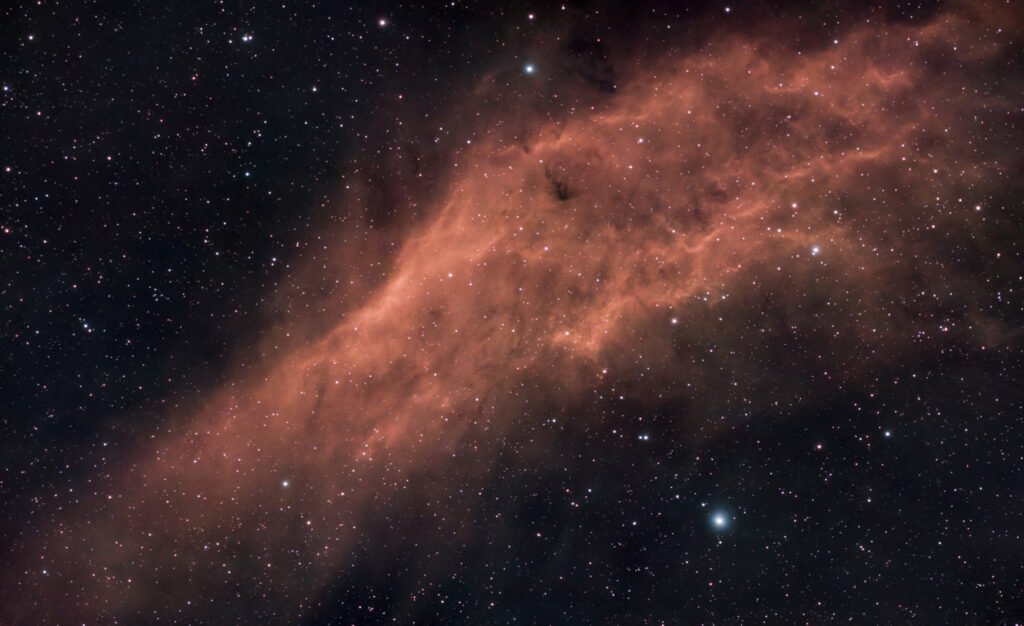
This is my latest Dwarf 3 capture, clocking in at 23 hours 5 minutes of integration (from a total 33+ hours collected over multiple nights). I went a bit deeper this time, stacking only the best frames with round stars—excluding the rest using PixInsight’s Subframe Selector to sharpen the details. The Dwarf 3 really shines here, handling the long exposures effortlessly and pulling out the nebula’s intricate filaments even from my Bortle 6 backyard. If you’re curious about how this smart telescope performs on wide-field targets like this, check out my full review video below—it’s packed with tips on setup, stacking, and why it’s a game-changer for urban imagers.