Deep in the constellation Perseus lies one of the most striking stellar nurseries in the northern sky: NGC 1579, known as the Northern Trifid or Trifid of the North. Discovered by William Herschel on 27 December 1788, this compact nebula is a near-perfect miniature version of its famous southern counterpart, M20 in Sagittarius.
At a distance of roughly 2,100 light-years (with estimates ranging 2,000–2,400 ly depending on the study), and spanning just 3–4 light-years across, NGC 1579 sits embedded in the vast California Molecular Cloud—a giant star-forming complex named after the nearby California Nebula (NGC 1499).
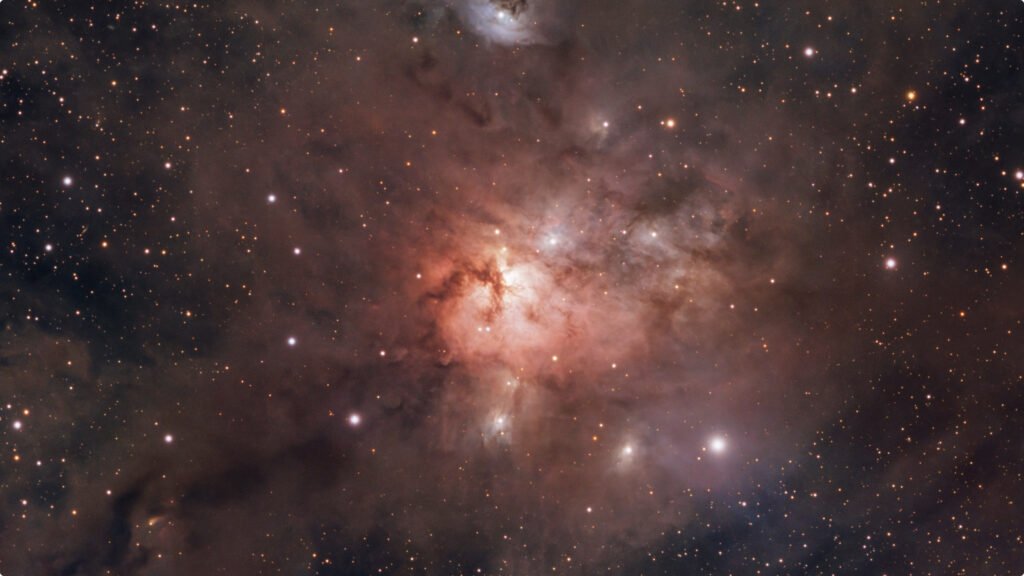
What makes NGC 1579 so special is that it is both a reflection nebula and an emission nebula at the same time. First, the bright blue areas are created when starlight bounces off thick clouds of cosmic dust. At the same time, a very young and massive star hidden inside — called LkHα 101 — lights up the surrounding hydrogen gas, giving the nebula its glowing red colors. Because the dust is so thick, it also creates the dark, twisting lanes that slice through the nebula and give it the “Trifid” (three-part) name.
I used the following gear for this shot
| Category | Equipment | Links |
|---|---|---|
| Telescope | SVBony SV550 122mm Triplet APO | Watch My Review |
| Imaging Camera | ToupTek ATR3 CMOS 26000 KMA | Learn More |
| Mount | Sky-Watcher EQ6-R Pro | Learn More |
| Guiding Camera | ToupTek G3 CMOS 20000 KMA | Learn More |
| Filters | Scorpio Blue/Green/Red 36 mm (LRGB) | Learn More |
| Focal Reducer | SVBony SV209 2-inch 0.8x Focal Reducer (W9161B) | Learn More |
| Off-Axis Guider | ToupTek OAG | Learn More |
| Power Hub | WandererAstro WandererBox Plus V3 | Watch The Review |
| Flat Panel | WandererAstro WandererCover V3 | Learn More |
| Rotator | Pegasus Astro Falcon Camera Field Rotator v2 | Learn More |
This region has been a prime target for professional observatories. In 2013, the NASA/ESA Hubble Space Telescope captured a high-resolution view of NGC 1579, revealing fine details in the dust structures and star formation activity; it was featured as “The Trifid of the North” in Hubble’s Picture of the Week. The object has also appeared in NASA’s Astronomy Picture of the Day (APOD) and been studied using infrared and X-ray data from Spitzer and Chandra to map the young stellar objects hidden within its dusty core.
Captured over many clear nights from a Bortle 4.5 sky in Williamsburg, VA:
Acquisition & Coordinates Details
| Category | Details |
|---|---|
| Location / Sky Quality | Williamsburg, Virginia, USA – Bortle 4.5 |
| Frames | Scorpio Blue 36 mm: 149×300″ (12h 25′) Scorpio Green 36 mm: 235×300″ (19h 35′) Scorpio Red 36 mm: 223×300″ (18h 35′) |
| Total Integration | 50h 35′ (607 exposures) |
| RA Center | 04h 30m 03.84s |
| DEC Center | +35° 16′ 02.6″ |
| Pixel Scale | 1.137 arcsec/pixel |
| Orientation | 34.971 degrees |
| Field Radius | 1.003 degrees |
This pure RGB image—no narrowband filters—delivers colors as authentic as the optics and sky allow. The extensive integration time has unveiled subtle outer halos, intricate dust filaments, and faint extensions that shorter exposures simply cannot reach.
Check out the full resolution version of this image on AstroBin:
