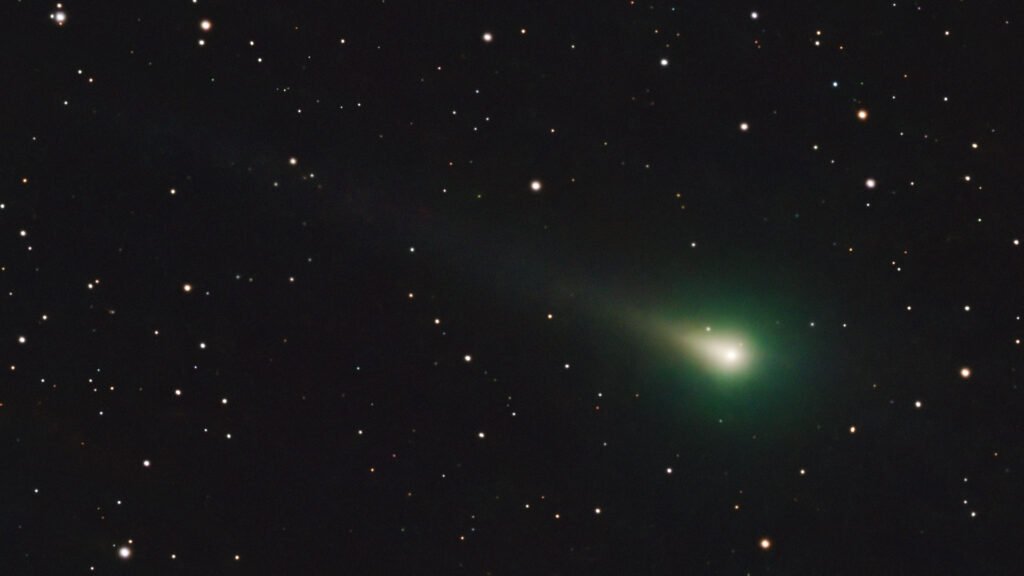
I took a picture of 3I/ATLAS, the third confirmed interstellar object to visit our Solar System, on December 21, 2025 – just two days after its closest approach to Earth on December 19. This rare cosmic traveler, also known as C/2025 N1 (ATLAS) and previously designated A11pl3Z, was discovered on July 1, 2025, by the NASA-funded Asteroid Terrestrial-impact Last Alert System (ATLAS) telescope in Río Hurtado, Chile. The Minor Planet Center confirmed its interstellar nature the following day, July 2, 2025, based on its hyperbolic orbit with an eccentricity greater than 1.
Traveling at an astonishing speed of up to 221,000 kilometers per hour (about 137,000 mph), 3I/ATLAS entered our Solar System from the direction of the constellation Lyra and reached its perihelion – closest point to the Sun – on October 29-30, 2025, at approximately 1.35-1.4 AU (about 126-130 million miles or 202-210 million kilometers), just inside the orbit of Mars. Its closest approach to Earth occurred on December 19, 2025, at a safe distance of about 1.8 AU (170 million miles or 270 million kilometers), posing no threat.
I used the following gear for this shot
| Category | Equipment | Links |
|---|---|---|
| Telescope | SVBony SV550 122mm Triplet APO | Watch My Review |
| Imaging Camera | ToupTek ATR3 CMOS 26000 KMA | Learn More |
| Mount | Sky-Watcher EQ6-R Pro | Learn More |
| Guiding Camera | ToupTek G3 CMOS 20000 KMA | Learn More |
| Filters | Scorpio Blue/Green/Red 36 mm (LRGB) | Learn More |
| Focal Reducer | SVBony SV209 2-inch 0.8x Focal Reducer (W9161B) | Learn More |
| Off-Axis Guider | ToupTek OAG | Learn More |
| Power Hub | WandererAstro WandererBox Pro V3 | Learn More |
| Flat Panel | WandererAstro WandererCover V3 | Learn More |
| Rotator | Pegasus Astro Falcon Camera Field Rotator v2 | Learn More |
With a nucleus estimated between 1,400 feet (440 meters) and 3.5 miles (5.6 km) across, 3I/ATLAS has shown active outgassing, developing a dusty coma and tail rich in carbon dioxide, water ice, carbon monoxide, and other volatiles – traits similar to Solar System comets but with unique interstellar signatures, such as delayed water vapor release and early high CO₂ levels. NASA’s coordinated observation campaign involved multiple missions: the Hubble Space Telescope provided sharp views of the nucleus and coma, the Parker Solar Probe captured tail and motion data from October 18 to November 5, 2025, using its WISPR imager, while MAVEN and Perseverance at Mars offered close-up ultraviolet and visible images. Additional contributions came from Psyche, Europa Clipper, STEREO, SOHO, and ground-based observatories. Additional pre-discovery observations from telescope archives have helped refine its trajectory and composition.
As of December 22, 2025, the comet is outbound in the constellation Leo, slowly fading as it heads back into interstellar space at high speed, never to return. This ancient object, potentially billions of years old, offers invaluable insights into the formation of exoplanetary systems and interstellar chemistry. My 3-hour integration image reveals its subtle central condensation and coma against a rich starry field – a true highlight of 2025 astrophotography!
Acquisition & Coordinates Details
| Category | Details |
|---|---|
| Date | December 21, 2025 |
| Frames | Scorpio Blue 36 mm: 30×120″ (1h) Scorpio Green 36 mm: 30×120″ (1h) Scorpio Red 36 mm: 30×120″ (1h) |
| Total Integration | 3 hours (90 exposures) |
| RA Center | 10h 36m 12s.55 |
| DEC Center | +07° 55′ 47″.10 |
Check out the full resolution version of this image on AstroBin:
