I am happy to share my latest photograph of one of the most spectacular supernova remnants in the sky
The Eastern Veil (NGC 6992–6995) is the brightest arc of the Cygnus Loop — a huge bubble of gas blown apart by a star that exploded roughly 10 000–20 000 years ago. At about 2 400 light-years away, the entire Veil complex spans nearly 3 degrees (six full moons) across the summer sky in Cygnus. The delicate filaments we see are shockwaves still glowing from the original blast, lit up by oxygen (teal/blue) and hydrogen (red).
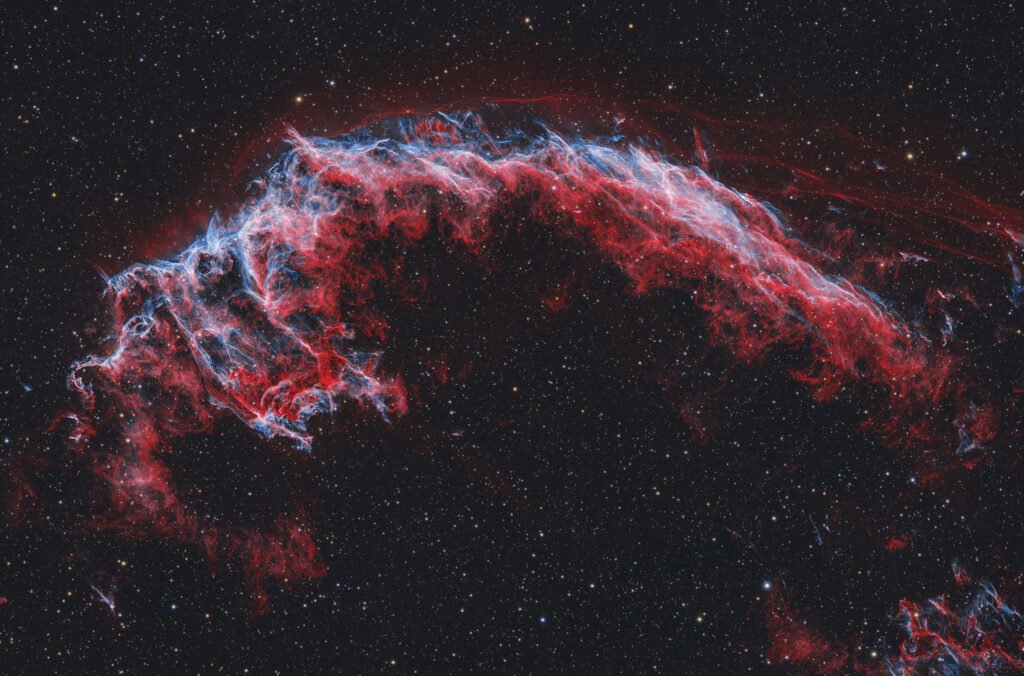
This 20 h 26 min image was captured with the new SVBony SV550 122 mm f/7 triplet APO and the monochrome ToupTek ATR3CMOS 26000 KMA camera. I used individual 5 nm Ha and OIII filters plus RGB for the stars, giving the classic Hubble-palette look while keeping the stars natural.
Gear highlights
- SVBony SV550 122 mm Triplet APO + SV209 0.8× reducer
- ToupTek ATR3CMOS 26000 KMA (mono)
- Scorpio 5 nm Ha & OIII + RGB filters (36 mm)
- Sky-Watcher EQ6-R Pro, off-axis guiding, Pegasus Falcon Rotator 2
- Processed in PixInsight and Photoshop
This is one of my longest integrations yet, and the 122 mm aperture really pulled out the faint outer wisps and the intricate “braided” texture along the main arc. The Veil never gets old — every extra hour of exposure reveals more.
Hope you enjoy the view as much as I enjoyed chasing it over several clear nights!